Table of Contents
- Why Gentle Movement and Walking Help Your Back Heal
- How Long to Wait Before Exercising After a Back Injury
- What to Expect from Physiotherapy for Back Pain Recovery
- Step-by-Step: Your First Four Weeks of Back Injury Training
- Modifying Gym Workouts for Back Pain
- Exercises and Movements to Avoid During Recovery
- Red Flags, Pain Monitoring, and When to Stop
- The Mental Side of Returning to Training After a Back Injury
- Frequently Asked Questions
Last Updated: September 11, 2026
Why Gentle Movement and Walking Help Your Back Heal
The worst thing you can do for a healing back is nothing at all. Complete bed rest was once standard advice after a back injury, but clinicians now recognize that prolonged inactivity weakens the muscles supporting your spine and slows tissue healing (peer-reviewed research). Gentle movement is the foundation of how to safely start training after a back injury.
Walking is the simplest entry point. It raises your heart rate, increases blood flow to the injured area, and delivers oxygen and nutrients that accelerate tissue repair without loading your spine heavily. Many people find that a short, flat walk actually reduces stiffness and nerve pain compared to lying still.
The goal isn’t distance. It’s frequency. Three short walks a day beat one long one when you’re rebuilding tolerance.
Blood flow is the mechanism behind early recovery. Movement pumps nutrients into damaged tissue and clears inflammatory byproducts, which is why gentle walking often eases pain rather than aggravating it.
How Long to Wait Before Exercising After a Back Injury
There’s no single number of days that fits everyone. The honest answer is that how to safely start training after a back injury depends on the type and severity of your injury, not the calendar.
For a mild strain, many people can begin gentle walking within a few days (mayoclinic.org). For disc-related pain or nerve involvement, the timeline stretches, and your physiotherapist should guide the decision. The signal to start isn’t a date. It’s whether you can move through basic daily activities with manageable discomfort.
A common mistake is waiting for zero pain before doing anything. That day may never arrive, and waiting too long costs you muscle and confidence.
Pushing into sharp, radiating pain to “test” your back is the fastest way to set recovery back weeks. A dull ache that eases as you warm up is different from a sharp or shooting sensation. Stop immediately if you feel the latter.
What to Expect from Physiotherapy for Back Pain Recovery
Physiotherapy for back pain recovery is a structured process, not a passive treatment. A physiotherapist assesses your range of motion, core stabilization, and movement patterns, then builds a plan around your specific injury.
Expect the first sessions to focus on assessment and gentle mobility drills. Your therapist will teach you controlled movement patterns and posture correction you can practice at home. As you progress, they add load management strategies and functional movement work.
Our physiotherapist and strength trainer Benson combines rehabilitation with strength work, which matters because the transition from clinic to gym is where most people get stuck. You don’t need to guess when you’re ready to add weight. Someone qualified can tell you.
Step-by-Step: Your First Four Weeks of Back Injury Training
This four-week framework assumes your physiotherapist has cleared you for gentle exercise. Treat it as a template, not a prescription. The point isn’t to hit every number, it’s to give you a structured way to add stress without crossing the line into a flare-up.
Two rules govern the whole month:
- Change one variable at a time. Add load, reps, range, or frequency, never two in the same week. If something flares, you need to know which change caused it.
- Use a 0-10 pain scale, not a pain-free-or-not test. A score of 0-2 that stays stable during and 24 hours after a session is acceptable (peer-reviewed research). A score that climbs past 3, or that’s higher the next morning, means you did too much.
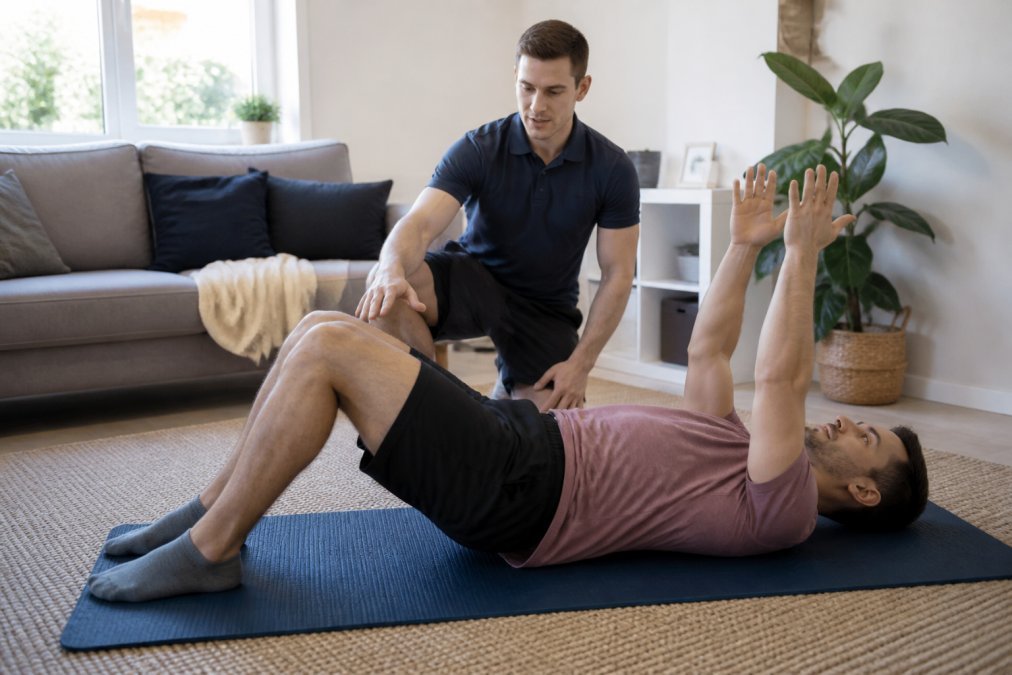
Week 1-2: Low-Impact Movement and Core Stabilization
Start with 10 to 15 minute walks on flat ground, once or twice daily. If a single 15-minute walk leaves you stiff the next morning, split it into two 7-minute walks instead, frequency beats duration early on.
Add core stabilization work: dead bugs, bird dogs, and pelvic tilts. These teach your deep abdominal and multifidus muscles to support your spine without loading it. Keep every rep slow and controlled, a 3-second hold at the end range is more useful than 20 fast reps.
A reasonable starting dose is 2 sets of 6-8 reps per movement, once daily. If that’s easy for a full week, add one set before you add reps.
Week 3-4: Adding Load and Functional Movement
If weeks one and two felt manageable, meaning pain stayed at 0-2 and didn’t spike the next day, introduce light resistance and functional movement. Bodyweight squats to a comfortable depth, glute bridges, and light band work build the muscles that protect your back.
This is where progressive overload begins, but slowly. A workable pattern is:
- Week 3: 2 sets of 8 reps, bodyweight only, 3 times weekly.
- Week 4: 3 sets of 8 reps, or 2 sets of 10, still bodyweight. Add a light band only if week 3 was clean.
Rest 60-90 seconds between sets. Stop a set when form breaks down, not when you hit a target number.
| Week | Focus | Example Movements | Frequency | Progression Rule |
|---|---|---|---|---|
| 1-2 | Low-impact movement, core | Walking, dead bugs, pelvic tilts | Daily, short sessions | Add frequency before duration |
| 3-4 | Light load, function | Bodyweight squats, glute bridges, band rows | 3-4 times weekly | Add one set, then reps, then load |
What to Do When a Session Flares Your Back
Flare-ups are normal in recovery and don’t mean you’ve re-injured yourself. What matters is how you respond.
- Mild spike (pain 3-4, eases within 24 hours): repeat the same session at 50% volume next time. If it’s clean, resume the original plan the session after.
- Moderate spike (pain 5+, or lasts more than 48 hours): drop back to the previous week’s plan for 5-7 days, then rebuild.
- Sharp, radiating, or new nerve symptoms: stop and contact your physiotherapist before your next session.
A dull ache that eases as you warm up is different from a sharp or shooting sensation. Stop immediately if you feel the latter, and don’t try to “work through” it.
The goal of the first month isn’t progress, it’s calibration. You’re learning what your back tolerates so that weeks five and beyond can add load with confidence instead of guesswork.
Modifying Gym Workouts for Back Pain
Modifying gym workouts for back pain is less about avoiding the gym and more about changing how you use it. Most standard exercises can be adjusted rather than abandoned, the trick is knowing which variable to change and why.
Two mechanical forces matter most for a healing spine:
- Compression, vertical load pushing the vertebrae together. Manageable in many cases, and often what you want to build tolerance to.
- Shear, a sliding force across the spine, usually from bending or twisting under load. This is the one to minimize early on.
Most safe substitutions work by reducing shear while keeping compression moderate. That’s the principle behind every swap below.
Free Weights vs. Machines
Free weights demand more stabilization from your core and back, which is good long-term but risky early. Machines fix your torso in a neutral position and let you isolate a muscle without asking your spine to hold a position under load.
- Barbell back squat → goblet squat or leg press with lumbar support. A goblet squat keeps the load in front of you, which tends to keep your torso more upright and reduces the forward-bend shear of a back squat. A leg press with a supported back removes spinal loading almost entirely.
- Standing overhead press → seated, supported press. A bench with back support removes the need to brace your spine against an overhead load.
- Bent-over row → chest-supported row. Lying face-down on an incline bench takes your lower back out of the equation while still loading the mid-back.
- Conventional deadlift → trap bar deadlift. A trap bar shifts the load closer to your midline and lets you keep a more upright torso, which reduces the shear a straight bar creates.
How to Set Up the Equipment
Small setup changes make a bigger difference than most people expect:
- Cable machines: set the pulley at chest or hip height for rows and presses so the line of pull doesn’t force you to lean or twist. Adjust the seat so your torso is vertical, not slumped.
- Leg press: set the back pad so your hips and lower back stay flat against it through the full range. Don’t let your lower back round off the pad at the bottom.
- Benches: use an incline of 30-45 degrees for supported rows and presses, enough to unload the spine without putting your neck in an awkward position.
- Bands: anchor at chest height for rows so you pull horizontally rather than up, which keeps your torso neutral.
Warm-Up and Tempo
Warm-up protocols matter more now than ever: five to ten minutes of mobility drills before any load. Cat-cow, hip flexor stretches, and glute bridges off a bench are a reasonable starting sequence.
Tempo is an underused tool. Slowing the lowering phase to 3 seconds gives your tissues more time under tension at a lower load, which builds tolerance without the peak force of a fast rep. If a movement feels fine at slow tempo but pinches when you speed up, stay slow for another week.
Film one set of each new exercise from the side. Most people can’t feel a subtle rounding of the lower back, but they can see it. A 10-second phone video is the cheapest form check you’ll ever get.
A common mistake is copying a general program from the internet. Generic plans don’t account for your injury, and the movements that are safe for one person can flare another. The swaps above are starting points, your physiotherapist or trainer should confirm which ones fit your specific injury.
Exercises and Movements to Avoid During Recovery
Some movements are worth shelving until you’re further along. Heavy spinal loading, loaded spinal flexion, and explosive twisting are the main offenders. Think heavy deadlifts, sit-ups with resistance, and any fast rotational movement under load.
This doesn’t mean forever. It means until your tissue healing has progressed and your core can handle the demand. Intensity modification, not permanent elimination, is the goal.
A common mistake is copying a general program from the internet. Generic plans don’t account for your injury, and the movements that are safe for one person can flare another.
Red Flags, Pain Monitoring, and When to Stop
Symptom monitoring is the skill that keeps you safe. Some soreness after training is normal. Certain symptoms are not.
Stop and seek medical advice if you notice:
- Numbness or tingling spreading down a leg or arm
- Weakness in a limb that wasn’t there before
- Loss of bladder or bowel control
- Pain that worsens over days rather than easing
The last two are urgent. Don’t wait to see if they improve.
For everyday monitoring, use a simple rule: pain should not increase during the session or the day after. If it does, you did too much. Reduce the load or range and try again. Overexertion is the most common reason people stall in recovery, and it’s entirely avoidable with honest tracking.
The Mental Side of Returning to Training After a Back Injury
Fear is the barrier nobody talks about. After a back injury, your nervous system learns to protect the area, and that protection can keep you from movements that are actually safe.
This is where a supportive coach changes the outcome. Our trainers work with beginners and people rebuilding from injury every week, so the hesitation you feel is familiar ground. Our physiotherapist and strength trainer Benson combines rehabilitation and strength training specifically to bridge the gap between “cleared by my therapist” and “confident in the gym.”
The mental hurdles are real: fear of re-injury, embarrassment about your fitness level, and the motivation dip that hits a few weeks in. Addressing them directly is part of the programming, not an afterthought.
Track how you feel, not just what you lifted. A simple note of “pain before / pain after” for each session gives you and your trainer a pattern to work from, and it turns vague fear into something you can actually manage.
Sleep and recovery protocols belong here too. Your tissue heals during sleep, so a consistent schedule and adequate rest are training inputs, not luxuries. Skip them and your progress stalls no matter how good your program is.
Most people don’t fail at back injury recovery because they trained too hard once. They fail because they never got a clear, safe plan for the transition from physiotherapy back to real training. If you’re in that gap, guessing is the worst strategy. Personal Trainer Plus offers fully customized fitness plans built around your injury, with injury-safe programming, proper form coaching, and flexible scheduling that fits around work. Our team includes a physiotherapist and strength trainer, certified trainers, and over 20 years of experience, and there are no long-term contracts. Claim your first session free and rebuild your strength with a plan that respects your recovery.
Frequently Asked Questions
When is it safe to start exercising after a back injury?
Most people can begin gentle movement within a few days of a strain, but the right timing depends on your specific injury. Start with walking and light mobility drills once sharp pain has settled. If you had a disc injury or surgery, wait for clearance from your physiotherapist or doctor. A good rule: if a movement increases pain that travels down your leg, stop and get assessed before continuing your back injury training.
Should I see a physiotherapist before returning to the gym?
Yes, especially if your pain lasted more than a week, radiated into your leg, or came with numbness or weakness. A physiotherapist can assess your range of motion, core stabilization, and movement patterns, then build a plan for physiotherapy for back pain recovery. They will also tell you which exercises are safe and which to avoid, so you do not guess your way back into a flare-up.
How do I modify my strength training routine to protect my spine?
Swap barbell back squats for goblet squats or leg press, replace deadlifts with hip hinges using light dumbbells, and use machines with lumbar support for rows and presses. Reduce range of motion if the bottom position causes pain, and keep loads light for the first few weeks. Modifying gym workouts for back pain is about controlling the variables: load, tempo, range, and rest. Increase one at a time, never all at once.
What are the red flag symptoms that mean I should stop training?
Stop immediately if you feel sharp pain that shoots down your leg, numbness in your groin or saddle area, loss of bladder or bowel control, sudden weakness in one leg, or pain that worsens over several sessions instead of improving. These signs need urgent medical assessment, not a training adjustment. Mild soreness that fades within 24 to 48 hours is normal; nerve symptoms are not.
